
Care Coordination For High Deducitble Health Plans
Over the past decade, we have seen a drastic shift in high-deductible health plans and employer-sponsored coverage. The average employer-sponsored family health insurance plan has risen to $26,000, with employees now covering 26% of that cost. At the same time, employers have increasingly shifted toward high-deductible plans, with more than 33% of plans now falling into this category. For those purchasing through the individual marketplace, approximately 58% of plans meet the criteria for a high deductible, defined as $1,700 for an individual and $3,400 for a family.
But what does a high-deductible plan mean for you, the patient? A deductible is the amount you pay out-of-pocket for health services before your insurance coverage begins. This can be frustrating; many patients consistently pay their monthly premiums but rarely meet their $3,000+ annual deductibles, essentially paying for coverage they rarely utilize. Once the deductible is met, patients are often still responsible to pay an amount, called coinsurance, which typically is 30% of the total bill. Ultimately, this results in patients paying monthly premiums, covering 100% of costs until the deductible is met, and then paying an additional 30% for care received. This cycle is both frustrating and financially burdensome for most families.
So, what is care coordination, and how does it help? Care coordination helps you navigate toward services that offer the highest quality care at the lowest cost. This can be facilitated through a Direct Primary Care office for individual patients or embedded as a service in modern employer-sponsored health plans, such as Doctor Delivery or Planstin.
Consider a recent experience I had when my son needed his tonsils and adenoids removed. When his ENT referred us to a large local pediatric hospital for the surgery, we called to obtain a price estimate. With our high-deductible ($3,500) insurance, the cost would be $10,496, leaving us responsible for $5,500. Without insurance, the same procedure at that hospital would cost $23,486. It sounds like a significant discount, right? Not when you consider that the majority (65%) of that cost is attributed to the facility—the hospital—rather than the doctors performing the procedure. We then contacted a small, private ENT office that performed the surgery at an outpatient surgery center. They quoted us $3,872, regardless of whether we used insurance or paid cash. We chose this route, as the surgeon had excellent reviews and outcomes. The procedure went smoothly, the recovery was quick, and the nursing staff and physicians were highly professional and supportive.
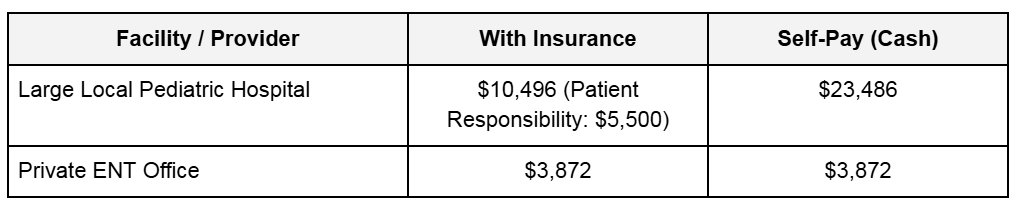
Same procedure, wildly different prices. By actively navigating healthcare costs, we saved thousands of dollars. This is what a care navigator—within a health plan—can accomplish, resulting in lower costs of care, lower premiums, and even better patient outcomes. It is time to rethink our health benefits by changing how we navigate the healthcare system. Give us a call at Core Family Practice to discuss how this can work for you.
