
The Truth About Perimenopause
If you’re a woman in your late 40s or early 50s, you may be experiencing changes in your health - our menstrual cycle is more irregular, you aren't sleeping as well, maybe you're losing your train of thought mid-sentence or walking into rooms and forgetting why you're there way more often than you did a few years ago. You may have read or heard that this could be the work of your hormones, so you ask to have your hormones checked with lab work. You're surprised to hear the answer is no, that's not necessary. Or perhaps someone already did check your hormones and they came back normal. Why!?
To better understand this, we first need to understand the hormones that are involved, and then how they are changing during peri-menopause.
Estradiol: This is your primary type of estrogen before menopause. It’s made in the ovaries and helps numerous systems in your body: your bones, heart, sleep, mood, and brain.
Progesterone: It rises in the second half of your menstrual cycle, but only when you ovulate. It helps with sleep and keeps your cycle predictable. This is usually the first hormone that quiets down–which is the first absence you start to feel.
FSH: Stands for follicle-stimulating hormone. It’s made in the pituitary gland (at the base of your brain) and acts as a signal, sent to your ovaries, to tell them to amp it up. When your ovaries aren’t doing their job, this signal gets louder and louder. When your ovaries are struggling, your FSH gets higher.
LH: The acronym for leuteinizing hormone. Also made in the pituitary gland, this signal is sent to trigger ovulation. It rises quickly in the middle of your cycle (when your menstrual cycle is regular). During perimenopause, it’s no longer just active mid-cycle as it was before–the timeline is disorganized.
The timeline? What is this timeline and how is it even supposed to work when you’re menstruating predictably? Every hormone has a job and a schedule that allows it to properly carry out that job. Here’s how it looks visually:
Hormones during a typical menstrual cycle:
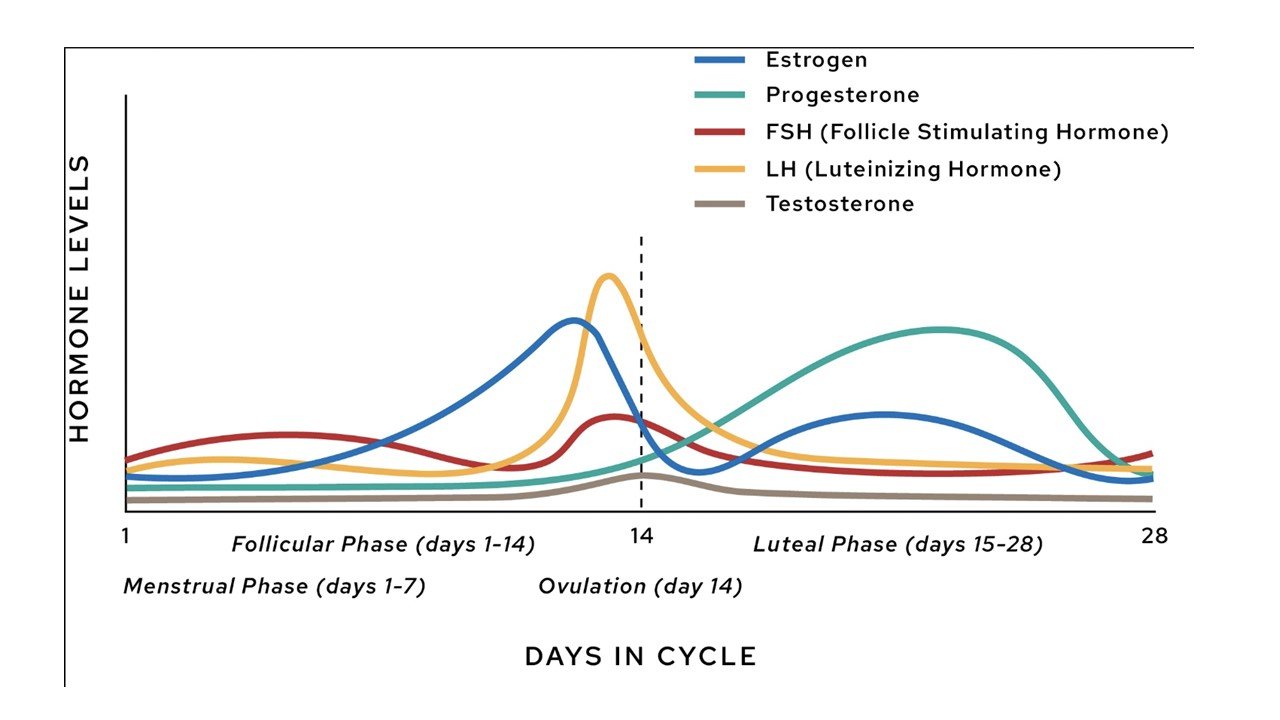
Estradiol: Climbs during the first half of your cycle to grow a follicle and peaks right before ovulation, then drops off dramatically.
Progesterone: Rises after ovulation (it’s produced by what is left over after the follicle is released) and then falls again at the end of the cycle if there is no pregnancy.
FSH: Stays low, with just a small increase at the start of the cycle.
LH: Stays low until right before ovulation when it rises and falls very quickly.
So, how does this change during peri-menopause? The same four hormones are involved, but instead of each hormone rising and falling in a predictable and organized dance, it’s much more chaotic and unpredictable.
Hormones during perimenopause:
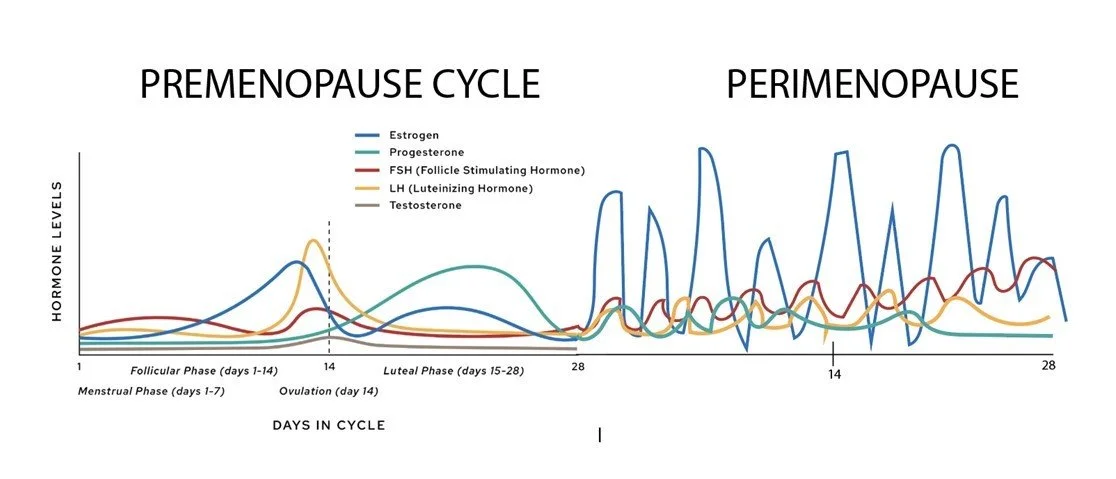
Estradiol doesn’t calmly climb and gently taper any more–it raises and falls unpredictably, sometimes to even higher levels that you’ve experienced in decades. On Monday it may be sky-high, then on Friday at its lowest.
Progesterone: This tends to drop off first. You don’t ovulate every single month any more and when you don’t ovulate, you don’t make progesterone. This early drop is one you tend to feel.
FSH: This signal, which you’ll remember sends a message to your ovaries to do their job, gets louder and louder. You’re not ovulating every month and your pituitary gland makes FSH to yell at your ovaries: “work harder!”.
LH: LH used to be predictable, low, just a little bump before ovulation. Now it’s chaotic. Sometimes it’s higher, sometimes it’s lower, and the lab value today won’t match the lab value over the weekend.
When you collect a single lab, you get a single piece of information: what your hormones are doing at that singular moment in time. In perimenopause, that information is useless on its own. You might catch your estrogen when it is through the roof, or maybe on a day it’s in the toilet. Both of these moments happened, and the labs are correct. But, they don’t tell the full story. Besides the fact that levels are constantly swinging, two women with the same exact estradiol number may feel completely differently–and how you feel is what really matters.
So, how do we know you’re in menopause, if not with labs? The answer is simple: you’ve gone 12 months in a row without having a period. This is what we call a clinical diagnosis. The American College of Obstetricians and Gynecologists (ACOG) and The Menopause Society, the national expert societies on menopause in the U.S., recommend against checking labs routinely to diagnose menopause. It’s not out of laziness, but rather because the lab value doesn’t help reach a diagnosis or formulate a plan.
What about testosterone? Testosterone is made in small quantities in the ovaries as well as in a little gland next to the kidneys, called the adrenal gland. Levels of testosterone tend to decrease slowly and without symptoms starting around your 30s. The only solid evidence in support of using testosterone is for low libido. Some perimenopausal or menopausal women with low libido experience increased sex drive when they take testosterone (remember, there is no “correct” quantity of libido, what matters is how you feel about whatever amount of libido you have). Even when women have low libido that they’re bothered by, we don’t check testosterone first to decide if they should supplement with testosterone or not. We check it simply to make sure it doesn’t go too high once you’re taking it.
Once you’ve reached menopause, or in other words once you’ve gone 12 months without a period, your hormones tend to stabilize. Instead of the hormonal chaos that is perimenopause, in menopause your estradiol remains stably low while your FSH remains stably high. Now, the labs will tell an accurate picture day-to-day. But, they still aren’t useful. We already know you’re in menopause because you’ve gone 12 months without a period–labs don’t add anything to this story.
References:
Santoro N. Perimenopause: From research to practice. J Womens Health (Larchmt). 2016;25(4):332-339. doi:10.1089/jwh.2015.5556
The 2022 hormone therapy position statement of The North American Menopause Society. Menopause. 2022;29(7):767-794. doi:10.1097/GME.0000000000002028
Jessica Grub, Jasmine Willi, Hannah Süss, Ulrike Ehlert,
The role of estrogen receptor gene polymorphisms in menopausal symptoms and estradiol levels in perimenopausal women – Findings from the Swiss Perimenopause Study, Maturitas,
Volume 183, 2024, 107942, ISSN 0378-5122, https://doi.org/10.1016/j.maturitas.2024.107942.
Lumsden MA, Dekkers OM, Faubion SS, et al. European Society of Endocrinology clinical practice guideline for evaluation and management of menopause and the perimenopause. Eur J Endocrinol. 2025;193(4):G49-G81. doi:10.1093/ejendo/lvaf206
American College of Obstetricians and Gynecologists. Do I need hormone testing before hormone therapy? American College of Obstetricians and Gynecologists website. Accessed July 12, 2026.https://www.acog.org/womens-health/experts-and-stories/ask-acog/hormone-testing-before-hormone-therapy
Choosing Wisely Canada; Society of Obstetricians and Gynaecologists of Canada. Obstetrics and gynaecology: twelve tests and treatments to question. Choosing Wisely Canada website. Updated August 2021. Accessed July 12, 2026.http://choosingwiselycanada.org/recommendation/obstetrics-and-gynaecology/
Davis SR, Baber R, Panay N, et al. Global consensus position statement on the use of testosterone therapy for women. J Clin Endocrinol Metab. 2019;104(10):4660-4666. doi:10.1210/jc.2019-01603
The Menopause Society. Clinical Practice Pearl: Testosterone Prescribing for Women. The Menopause Society; 2023. Accessed July 12, 2026.https://menopause.org/wp-content/uploads/professional/practice-pearl-testosterone_.pdf
